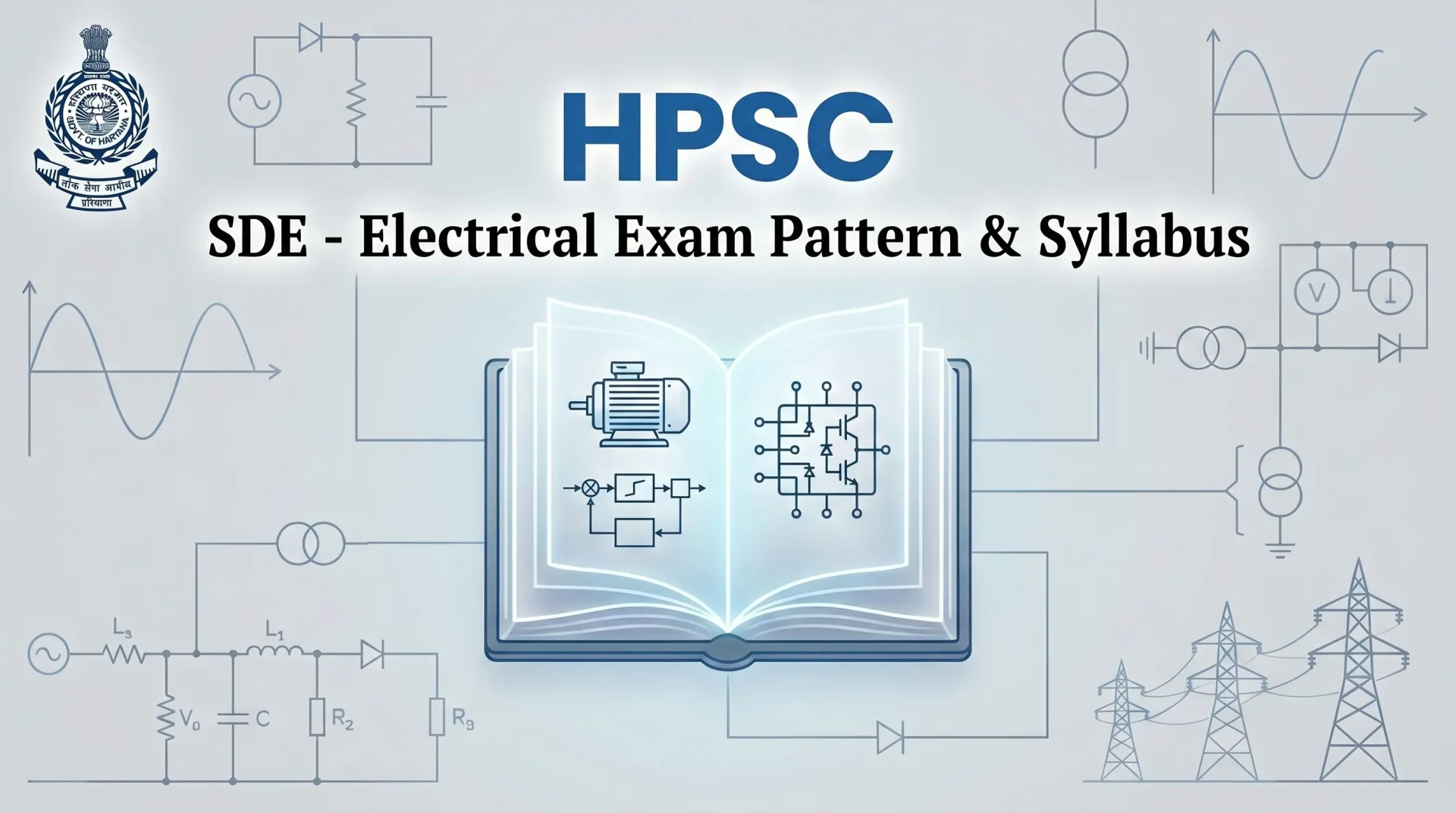
HPSC SDE Electrical Syllabus 2026: Haryana Public Service Commission (HPSC) has released the Subject Knowledge Test Syllabus and Exam Pattern for the post of Sub Divisional Engineer (Electrical) Group-B in the Development & Panchayats Department, Haryana under Advertisement No. 2/2026. Candidates preparing for the examination should thoroughly understand the latest syllabus and exam scheme before starting their preparation.
The Subject Knowledge Test will cover core Electrical Engineering subjects including Electrical Circuits, Electromagnetic Fields, Signals & Systems, Electrical Machines, Power Systems, Control Systems, Measurements, Electronics and Power Electronics. Since the written examination carries the highest weightage in the final selection process, candidates should focus on technical concepts and numerical problem-solving.
HPSC SDE Electrical Syllabus 2026 Overview
| Particulars | Details |
|---|---|
| Commission | Haryana Public Service Commission (HPSC) |
| Post Name | Sub Divisional Engineer (Electrical) |
| Department | Development & Panchayats Department, Haryana |
| Advertisement No. | 2/2026 |
| Exam Type | Subject Knowledge Test |
| Exam Mode | Written Examination |
| Paper Type | Subjective |
| Language | English |
| Official Website | hpsc.gov.in |
Exam Pattern
The Subject Knowledge Test will be conducted as per the scheme announced by HPSC.
| Particulars | Details |
|---|---|
| Exam Duration | 3 Hours |
| Total Marks | 150 Marks |
| Question Paper Type | Subjective |
| Language of Paper | English |
| Minimum Marks for Interview | 35% |
| Weightage of Written Test | 87.5% |
| Weightage of Interview | 12.5% |
Candidates must secure at least 35% marks in the Subject Knowledge Test to become eligible for the interview stage.
Selection Process
The selection process consists of the following stages:
| Stage | Details |
|---|---|
| Subject Knowledge Test | 150 Marks |
| Interview / Viva-Voce | Conducted by HPSC |
| Final Merit List | Written Test + Interview Marks |
The final merit list will be prepared by adding the marks obtained in the Subject Knowledge Test and Interview.
Interview Criteria
| Particulars | Details |
|---|---|
| Eligibility for Interview | Minimum 35% Marks in Written Exam |
| Candidates Called | Three Times the Number of Vacancies |
| Interview Weightage | 12.5% |
| Attendance | Mandatory |
Candidates who fail to attend any stage of the examination process will not be considered for final selection.
Syllabus Section 1: Electrical Circuits
This section focuses on fundamental circuit analysis and network theory concepts.
| Topics Covered |
|---|
| Ideal Voltage and Current Sources, Dependent Sources, R, L, C, M Elements, KCL and KVL, Node Analysis, Mesh Analysis, Thevenin’s Theorem, Norton’s Theorem, Superposition Theorem, Maximum Power Transfer Theorem, Transient Response of DC and AC Networks, Sinusoidal Steady-State Analysis, Resonance, Two-Port Networks, Balanced Three Phase Circuits, Star-Delta Transformation, Complex Power and Power Factor |
Section 2: Electromagnetic Fields
This section covers electric and magnetic field theory.
| Topics Covered |
|---|
| Coulomb’s Law, Electric Field Intensity, Electric Flux Density, Gauss Law, Divergence, Electric Field Due to Point, Line and Plane Charges, Dielectric Medium, Capacitance, Biot-Savart Law, Ampere’s Law, Curl, Faraday’s Law, Lorentz Force, Inductance, Magnetomotive Force, Reluctance, Magnetic Circuits, Self and Mutual Inductance |
Section 3: Signals and Systems
Candidates should prepare signal representation and system analysis topics.
| Topics Covered |
|---|
| Continuous and Discrete Time Signals, Shifting and Scaling Properties, Linear Time Invariant Systems, Causal Systems, Fourier Series, Periodic Signals, Sampling Theorem, Fourier Transform Applications, Laplace Transform, Z Transform, RMS Value, Average Value Calculations |
Section 4: Electrical Machines
Electrical Machines is one of the most important sections of the syllabus.
| Topics Covered |
|---|
| Single Phase Transformer, Equivalent Circuit, Open Circuit and Short Circuit Tests, Regulation and Efficiency, Three Phase Transformers, Transformer Connections, Vector Groups, Auto Transformer, DC Machines, Speed Control of DC Motors, Three Phase Induction Motors, Torque Speed Characteristics, Starting and Speed Control, Single Phase Induction Motors, Synchronous Machines, Cylindrical Rotor Machines, Salient Pole Machines, Generator Characteristics, Parallel Operation, Losses and Efficiency Calculations |
Section 5: Power Systems
This section evaluates the candidate’s understanding of generation, transmission and distribution systems.
| Electric Power Generation, AC and DC Transmission, Transmission Line Performance, Economic Load Dispatch, Series and Shunt Compensation, Electric Field Distribution, Insulators, Distribution Systems, Per Unit System, Bus Admittance Matrix, Load Flow Methods, Voltage Control, Frequency Control, Power Factor Correction, Symmetrical Components, Fault Analysis, Over Current Protection, Differential Protection, Directional Protection, Distance Protection, Circuit Breakers, System Stability, Equal Area Criterion |
Syllabus Section 6: Control Systems
| Topics Covered |
|---|
| Mathematical Modelling, Feedback Principles, Transfer Functions, Block Diagrams, Signal Flow Graphs, Transient Analysis, Steady State Analysis, Stability Analysis, Routh-Hurwitz Criterion, Nyquist Criterion, Bode Plots, Root Locus, Lead Compensation, Lag Compensation, Lead-Lag Compensation, PI Controller, PID Controller, State Space Model, State Equations |
Section 7: Electrical and Electronic Measurements
| Topics Covered |
|---|
| Bridges and Potentiometers, Measurement of Voltage, Measurement of Current, Measurement of Power, Measurement of Energy, Measurement of Power Factor, Instrument Transformers, Digital Voltmeters, Multimeters, Phase Measurement, Time Measurement, Frequency Measurement, Oscilloscopes, Error Analysis |
Section 8: Analog and Digital Electronics
| Topics Covered |
|---|
| Diode Circuits, Clipping and Clamping, Rectifiers, Amplifiers, Oscillators, Operational Amplifiers, Active Filters, Sallen Key Filters, Butterworth Filters, VCOs, Timers, Combinational Logic Circuits, Sequential Logic Circuits, Multiplexers, Demultiplexers, Schmitt Triggers, Sample and Hold Circuits, A/D Converters, D/A Converters |
Section 9: Power Electronics
| Topics Covered |
|---|
| Thyristor Characteristics, MOSFET, IGBT, Firing and Gating Circuits, DC to DC Converters, Buck Converter, Boost Converter, Buck-Boost Converter, Rectifiers, Bidirectional DC Voltage Source Converters, Harmonics, Power Factor, Distortion Factor, Single Phase Inverters, Three Phase Inverters, PWM Techniques |
Preparation Strategy
Candidates should prioritize Electrical Machines, Power Systems, Control Systems and Electrical Circuits as these areas typically carry significant weight in technical examinations. Regular numerical practice, revision of formulas and solving previous Electrical Engineering competitive exam questions can significantly improve performance. HPSC SDE Electrical Syllabus 2026
Since the paper will be subjective in nature, candidates should also focus on descriptive answers, derivations, diagrams and step-by-step numerical solutions. Time management during the 3-hour examination will be crucial for securing high marks. HPSC SDE Electrical Syllabus 2026
Important Links
Frequently Asked Questions (FAQs)
Q1. What is the duration of the HPSC SDE Electrical Subject Knowledge Test?
The examination will be conducted for 3 hours.
Q2. What is the total marks of the HPSC SDE Electrical written examination?
The Subject Knowledge Test carries 150 marks.
Q3. What is the minimum qualifying mark for the interview?
Candidates must secure at least 35% marks in the written examination to be eligible for the interview.
Q4. Is the HPSC SDE Electrical paper objective or subjective?
The Subject Knowledge Test will be subjective in nature.
Q5. What is the weightage of the Subject Knowledge Test in final selection?
The Subject Knowledge Test carries 87.5% weightage, while the interview carries 12.5% weightage.